Field Guide
Find the GOAT
The best answer out there. When we miss it, the herd finds it.
How it fits together
You ask. We look. The herd makes it better.
Ask
Type a question, a name, or a word. Any shape.
One answer
The best one we find, in the shape the question needs — steps, a chart, a box score — with its sources under it.
Rank it
Tap ▲ or ▼ and the results move for you right away.
Join a herd
People who follow what you follow. When enough of them agree, the ranking moves for everyone.
The Daily GOAT
Each morning, the best of what you follow, waiting for you.
When the answer misses, a ▲ on the right result fixes it for you today — and when the herd agrees, for everyone tomorrow.
The same loop, with real answers
Ask
how do I get rid of pantry mothsOne answer
Steps · 4 from hunker.com20 days130 degrees- Empty your pantry
- Clean everything — no exceptions
- Give it time
Rank it
How To Get Rid Of Pantry Moths Naturally▲ HERD ▼Moved to the top for this searchJoin a herd
Home & gardenYour ▲ ▼ help everyone in it find the GOAT.JoinThe Daily GOAT
Daily GOAT · SpursGame Recap: The Suns take down Wemby, Spurs, 102–98Box score, then the recap, the morning after.
Examples from the app.
Answers, not links · Every source shown · Learn something every day
The answer engine you own.
Ask anything. Get one clear answer with its sources — and a few minutes each morning on what you follow and what you’re learning.
Download for Windows
Not code-signed yet — Windows will show a SmartScreen box. Click More info → Run anyway. Why, and how to check the file
Also on macOS and Linux · On your phone
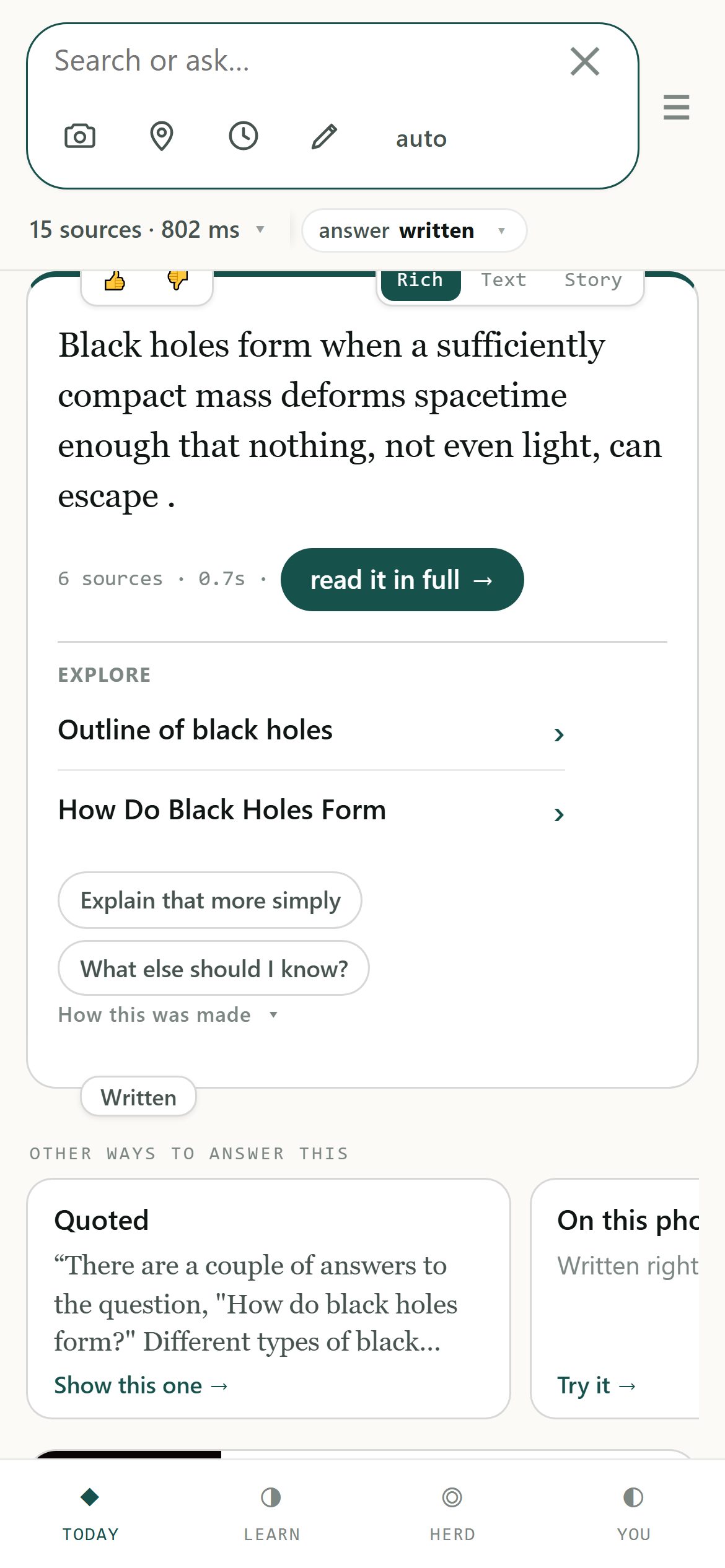
A quick tour
Here’s what it looks like.
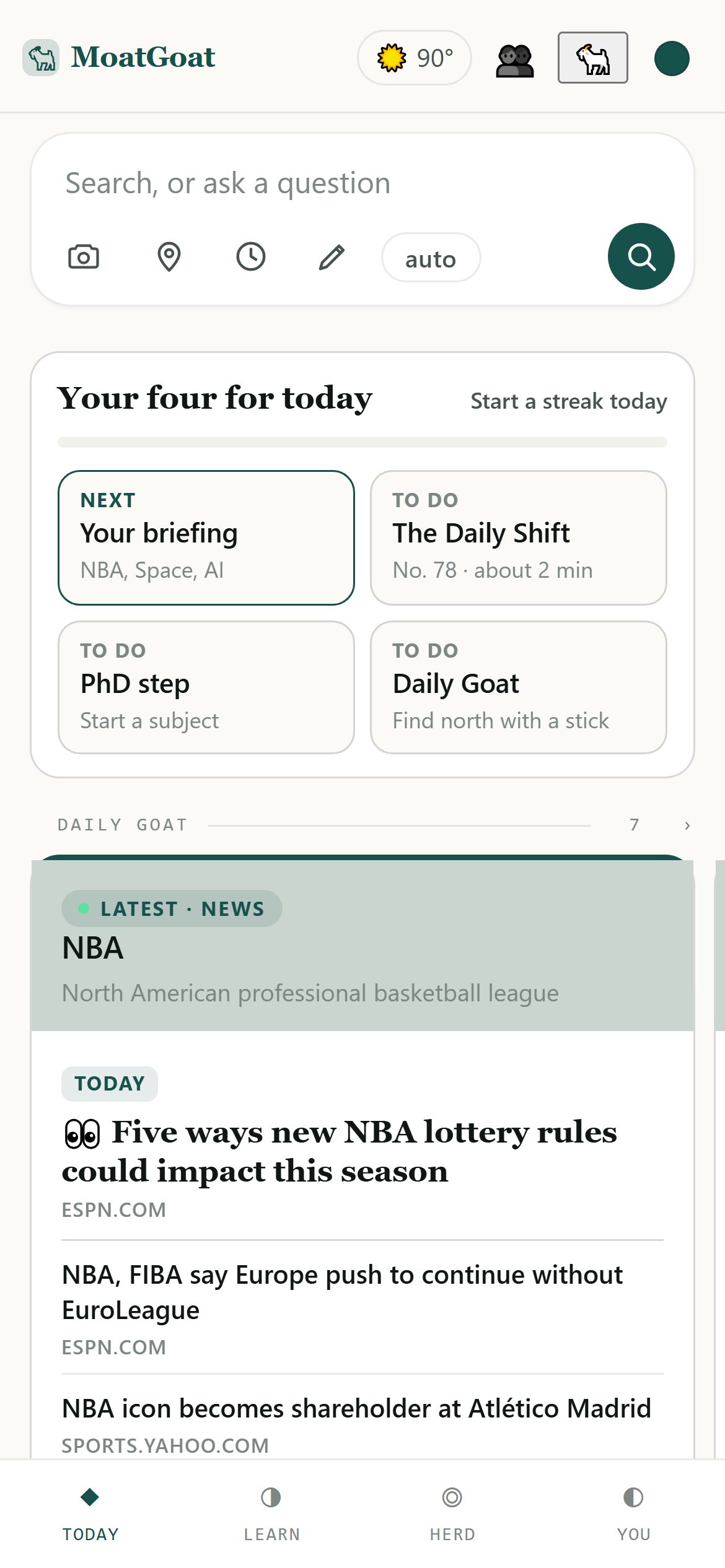 Your morningFour short things a day, and the news on what you follow.
- Ask anythingOne clear answer, with the sources it used.
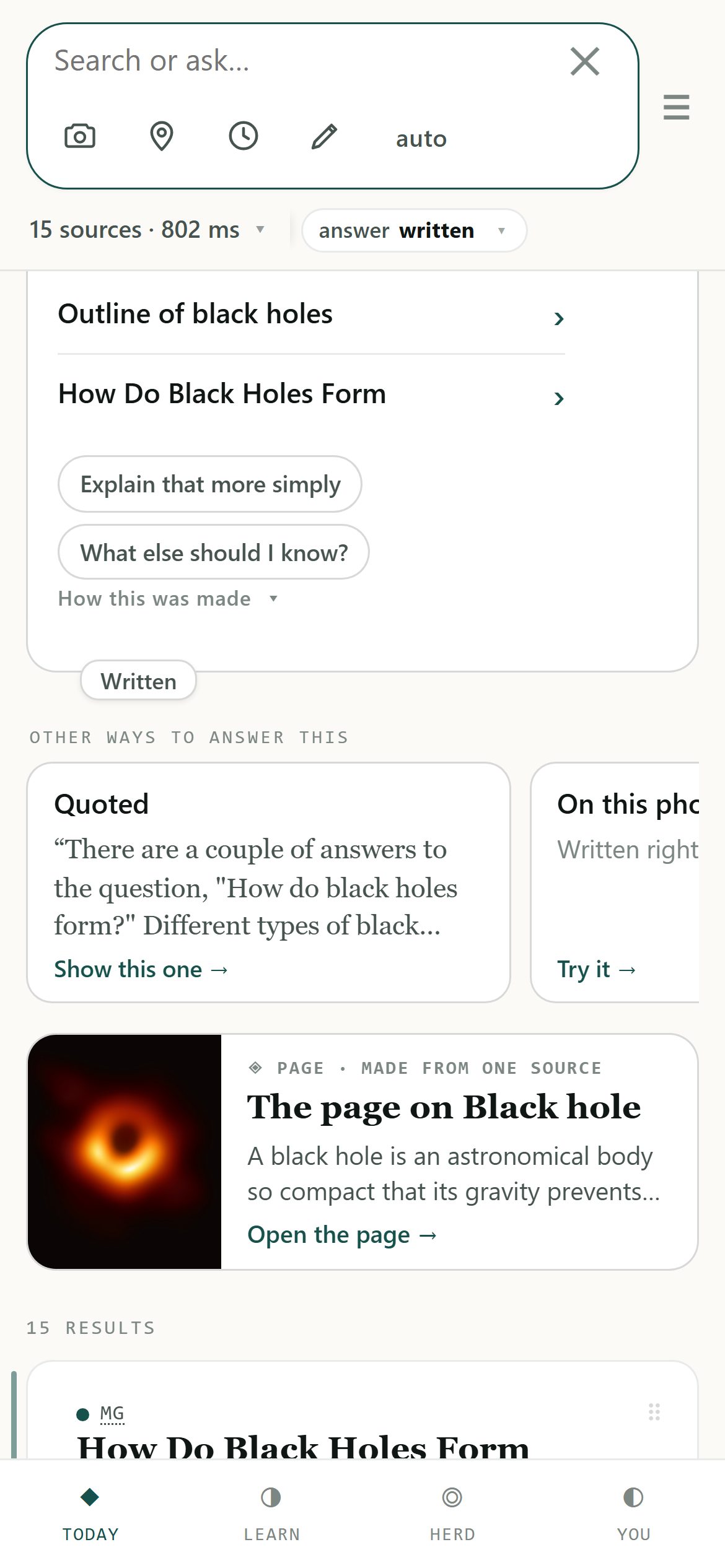 Other ways to answer itQuoted straight from a source, or written on your phone. Tap to swap.
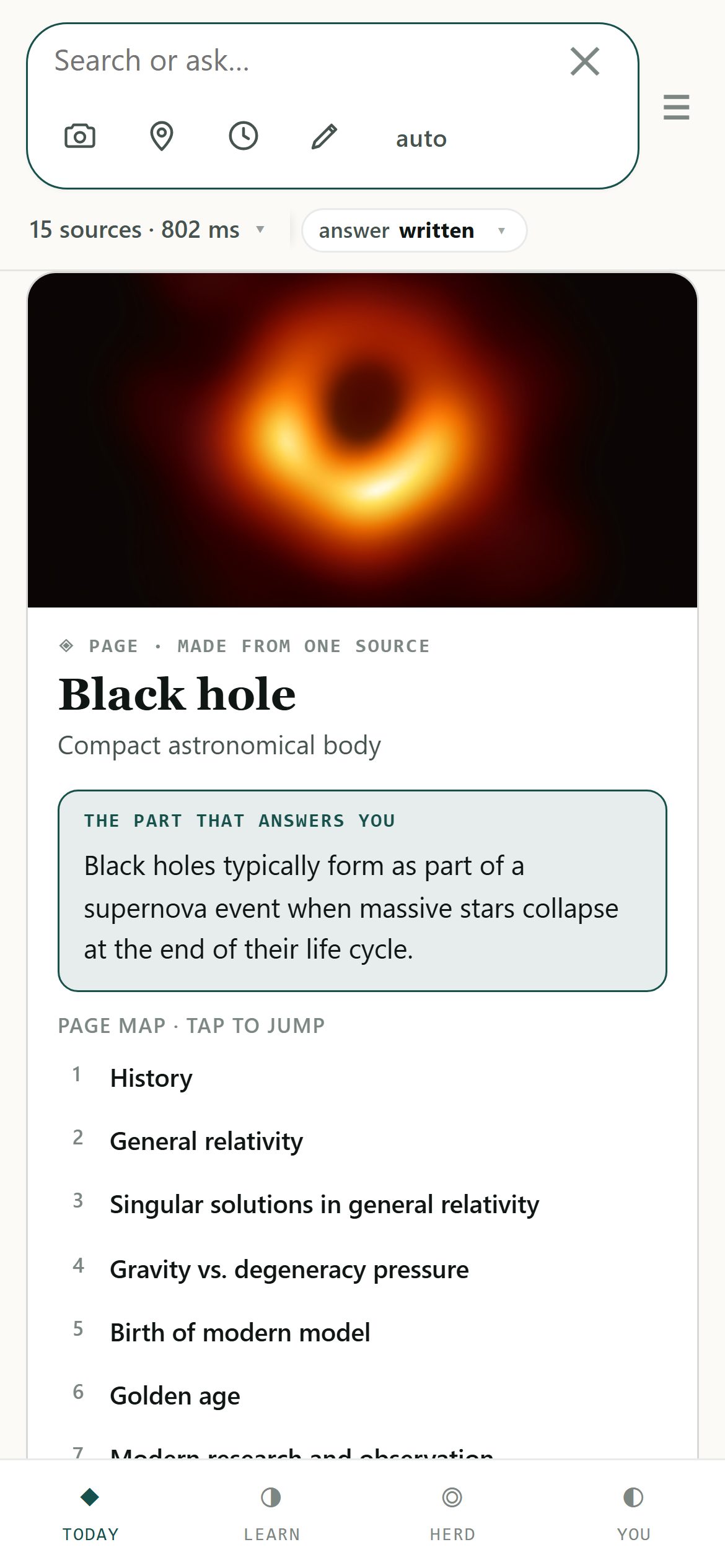 The pageOne good source, laid out to read.
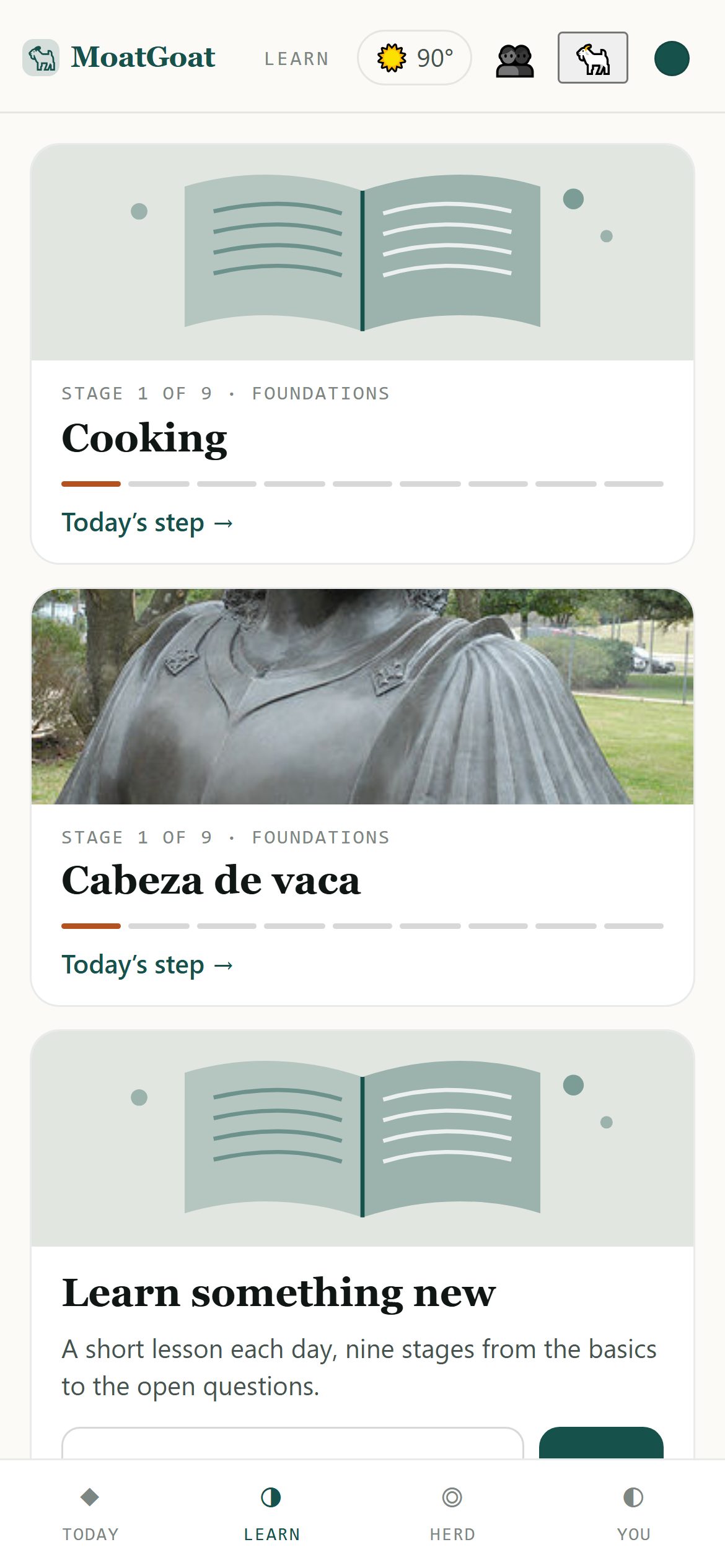 Learn somethingPick a subject. Each day brings the next step.
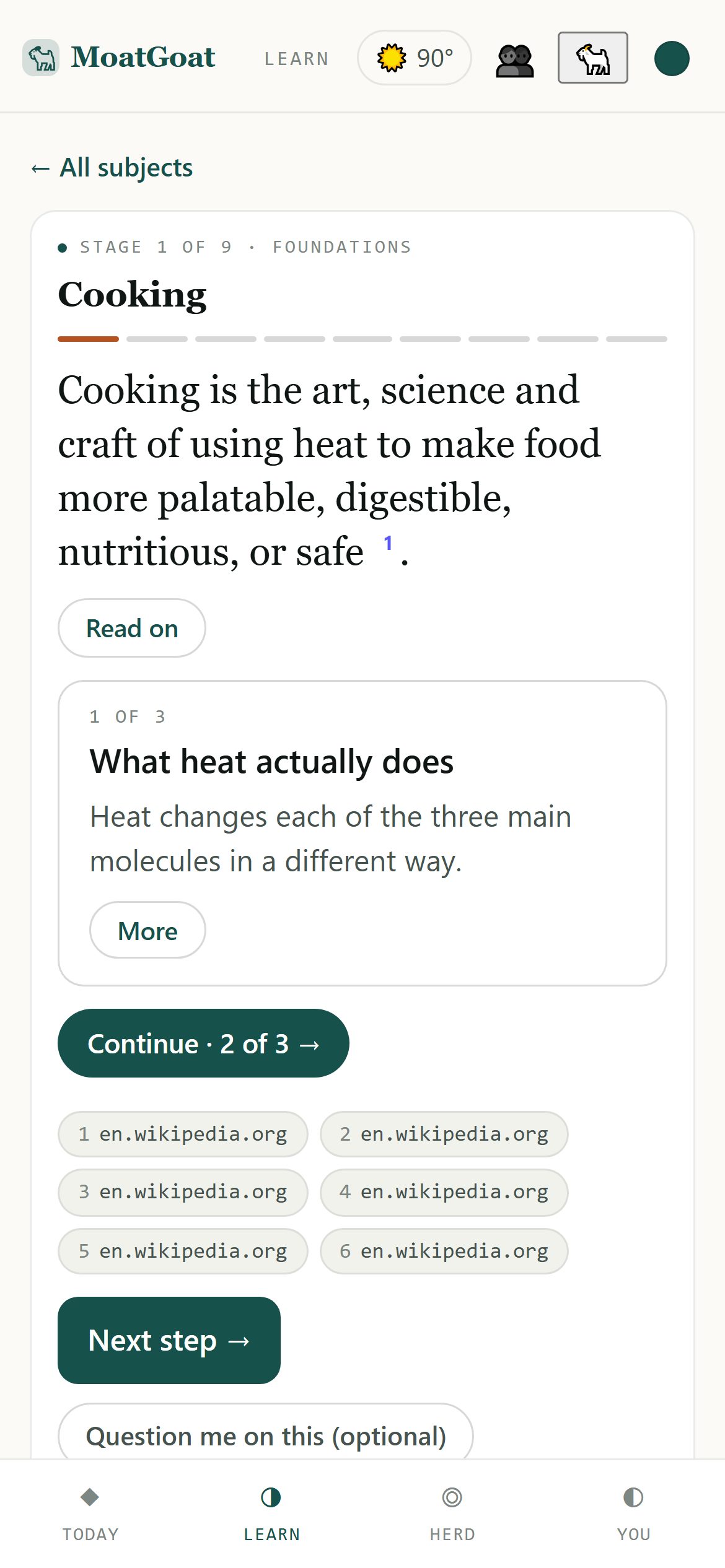 One step at a timeA sentence, then a part at a time. Questions are optional.
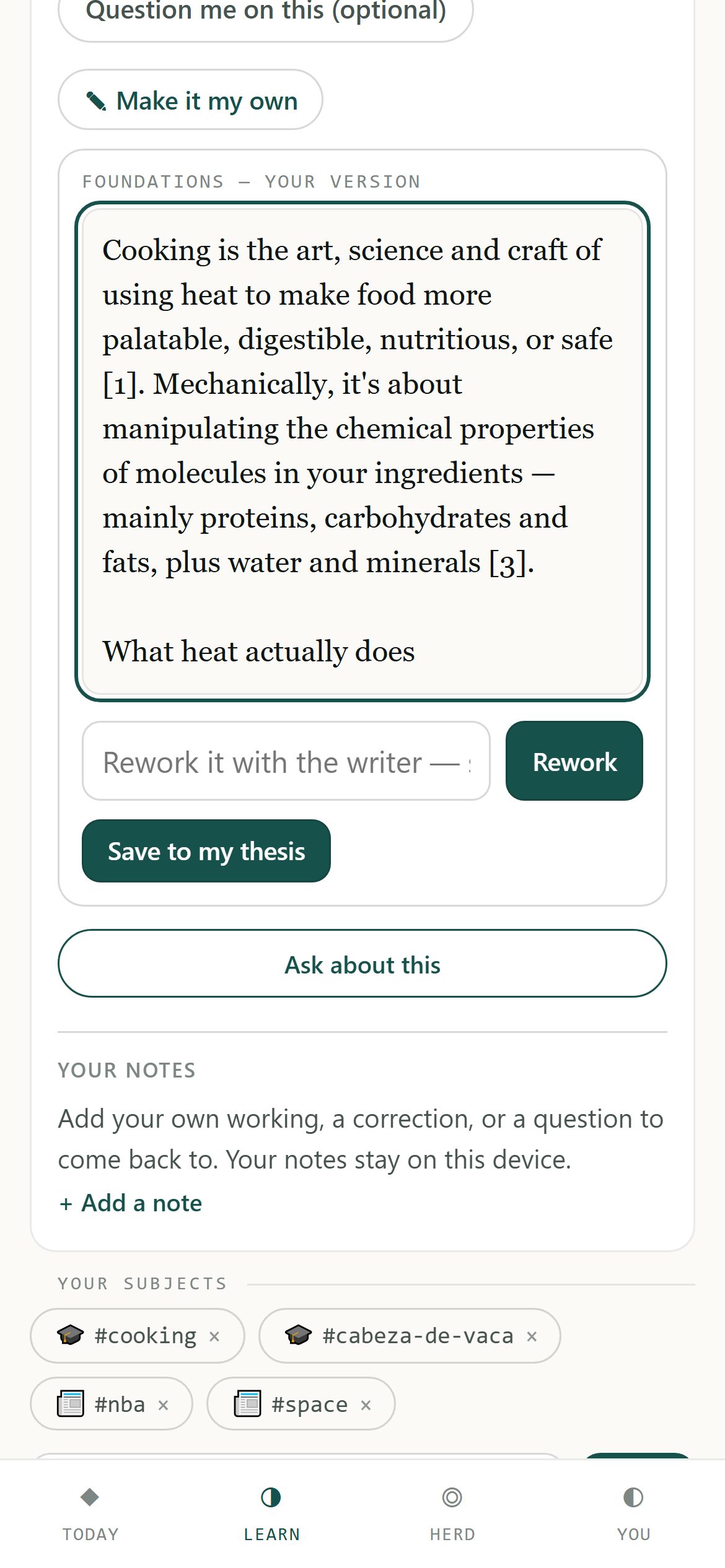 Make it your ownRework the lesson in your words and keep it.
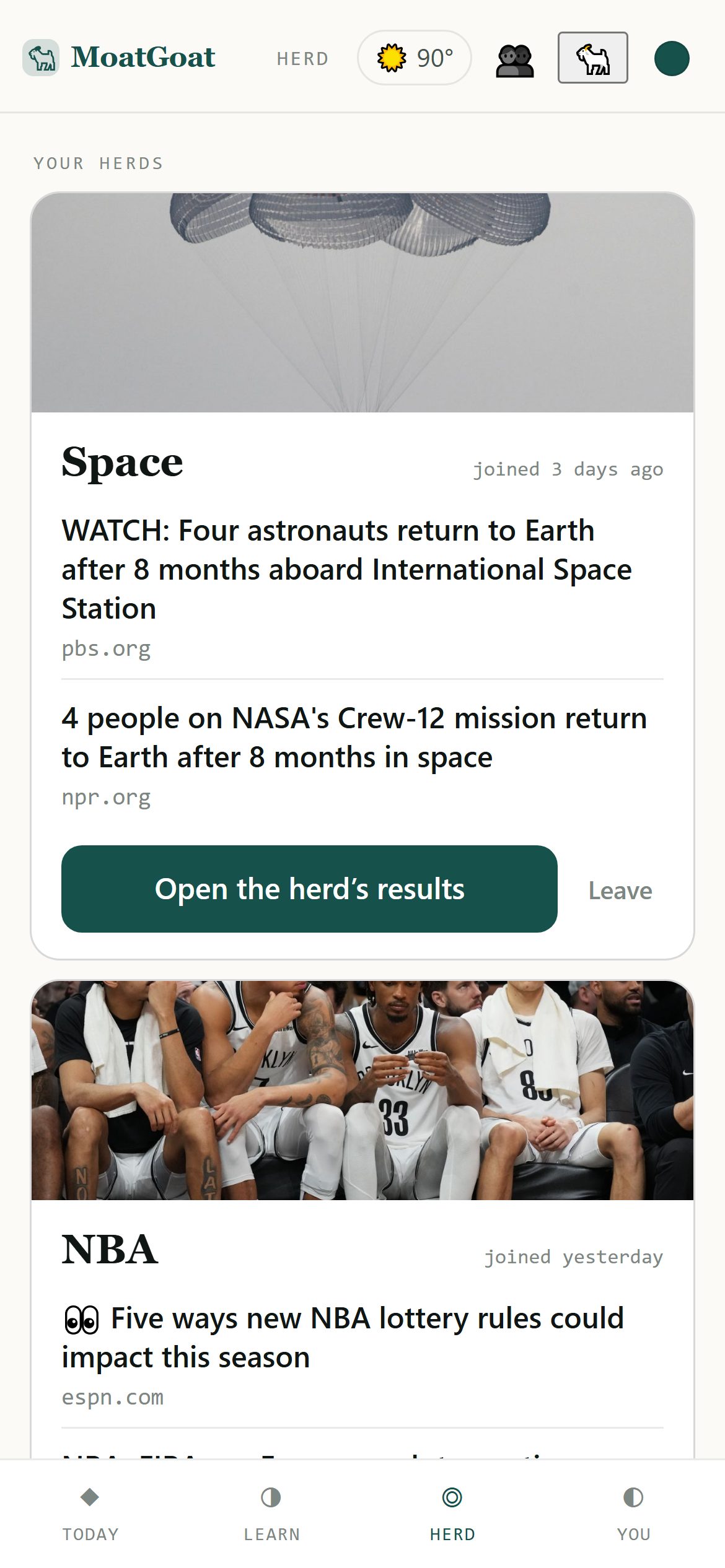 HerdsFollow a subject with other people, and rank it together.
Every day · A few minutes
It reads while you’re away.
Your news and today’s lesson, waiting each morning. Below is today’s actual work, live.
How the daily part works
FollowThe Spurs, your city, a medication — or something you want to learn, like an explorer or how a clock works. Tap Follow on any answer.
News or learningNews topics bring the latest, your country’s own papers first. Learning topics bring the next short step — with a question, if you want one.
Your four for todayA briefing, a short puzzle, a learning step and the Daily Goat — done in a few minutes, with a streak to keep.
HerdsFollow a subject with other people and your votes on its results help rank them for everyone in the herd.
What MoatGoat is
Made, not just found
An answer in the shape you need
Read more
A short read, the full write-up, a story with the numbers drawn, or a page built from one good source — and the other ways of answering it are a tap away, so you can compare them rather than take one on trust.
No ads
Nothing is bidding for the top
Read more
There is no ad slot, no sponsored row, no placement to sell. Ranking answers to one question only: is this the best source we have?
Learn it properly
A subject, one step a day
Read more
Pick something you want to understand. Each day brings the next of nine stages, grounded in its sources and shown one short part at a time. If you want, it questions you on each stage, and you can rework the lesson into your own write-up.
Verifiable
Every answer shows its work
Read more
Sources are attached to the claims they support. When the sources cover only part of a question, it leads with what they show and says plainly what’s missing — it doesn’t fill the gap by inventing.
One search in, a themed answer out
The answer takes the shape of the question.
Try one below.
Read more
A debugging answer and a field guide should not feel the same. MoatGoat reads what you asked, picks a structure to match, and lays the answer out to fit. The demo here runs the same code the app does.
People-powered
Its own index, curated by people.
Read more
Search stopped working when the people ranking it started getting paid by the people being ranked. MoatGoat removes the middleman rather than asking you to trust one.
-
01
A real index, not a search box
More
MoatGoat searches an index it built — whole pages, not just links — and ranks them by its own judgement. Every answer can name the pages it came from.
-
02
The herd curates what’s worth keeping
More
Join a herd and your votes help rank its subject for everyone in it — which sources held up, which turned out to be slop.
-
03
An answer you can argue with
More
Challenge a point and the answer re-sources itself and changes in place. When it’s right, you can publish it back to the herd.
-
04
Your way of answering, your call
More
Written, quoted, on your own machine, or with your own account — every answer says which way it was made, and the others are a tap away.
MoatGoat Answer
Field guide
identify this bird
A small thrush with a cobalt back and a rust-orange breast — almost certainly an Eastern Bluebird.
Field marks
The blue is unmistakable in good light; on a grey day the tell is the contrast — orange breast against a white belly. Females wear a muted version of the same pattern. See a photo comparison ›
Where to find
Open country with scattered perches — pasture edges, orchards, roadside wires. Year-round across the eastern U.S.
allaboutbirds.org
audubon.org
birdfact.com
An answer, as MoatGoat builds it — the format follows the question, and the sources come with it.
Get MoatGoat
Free, no account.
Installs in about 30 seconds; search straight away.
Before you install — signing, checksums, early build
None of these are code-signed yet. On Windows, SmartScreen shows a box —
More info → Run anyway. On macOS the build is not notarized, so the first
open is refused: use System Settings → Privacy & Security → Open Anyway
(right-click → Open no longer works on recent macOS). macOS will also not auto-update an
unnotarized build, so check back here for new versions. On Linux the AppImage needs no install
at all: chmod +x MoatGoat.AppImage and run it.
This build is not code-signed yet, and your computer will say so. Windows shows a blue “Windows protected your PC” box from SmartScreen — click More info, then Run anyway.
That warning does not mean the file is unsafe. It means nobody has paid a certificate authority to vouch for the publisher yet — and we would rather tell you that than have you find out at the download. Signing certificates are bought by a registered company; the company is being formed, and the builds get signed as soon as it exists. Until then the honest way to check you got the file we built is the checksum below.
Check the file you downloaded (SHA-256)
Windows — PowerShell: Get-FileHash .\MoatGoat.exe -Algorithm SHA256
- MoatGoat.exe — 1.35 GB
c7f583af6db663f12833e594aca132b955788636eb11523eca0e078359f8a25b
Upper or lower case doesn’t matter — PowerShell prints capitals, shasum prints lower case.
macOS and Linux checksums appear here when those builds are published — they are built on their own machines, and we will not print a hash for a file we have not produced.
This is an early build, and it reads like one. The engine, the local index and the grounded answers all work — but the index is young, so it is thin in places a mature one would not be. You are installing something early, not a finished product. When it can’t ground an answer it will tell you so rather than guess, which is the part we are least willing to compromise.
Three ways to run it — one of them today
On your desk, in your browser, or on a box in the cupboard.
Read more
Same engine underneath; the difference is where it lives and who else on your network gets to use it. Only the desktop app is finished — the other two say plainly where they’ve got to.
Shipped
Get the installer ›
Desktop app
More
The whole thing: your index, your model, grounded answers, the herd. Windows, macOS and Linux. This is the one to start with.
Installs and runs today. Not code-signed yet, so your OS will warn you once.
In progress
Loading instructions ship with the extension — not published yet
Browser extension
More
Keep the browser you have. Adds MoatGoat to the address bar, and — only if you switch it on — contributes the addresses of public pages you visit so the herd learns what is worth indexing. Never page content.
You can’t install this from a store yet. It works, but only loaded unpacked in developer mode. Nothing to click here unless you’re happy doing that.
Planned
Setup notes go public with the first flashable image
Home appliance
More
One always-on box — a Raspberry Pi will do — running the index for everything on your network, the way a Pi-hole does for ads. One copy of the index, shared by the whole house.
There is no image to flash yet. The node runs under Docker and serves an API on your LAN, but it has no web interface, so this is a build-it-yourself for now.
For developers · Substrate API
The quality layer, without the app.
Read more
The same thing that keeps slop out of a MoatGoat answer, as an endpoint. Send URLs, get back scored, deduplicated, flagged documents — with the reason codes for every call it made.
What it does
- We rank for youSend a query or your own retrieved URLs. Get clean originals back, and a list of what got collapsed and why.
- Or rank it yourselfPull the raw feature vectors — quality, flags, provenance, credibility, aggregate crowd-rank — and run your own ranker on your own infrastructure.
- Commons onlyEvery byte the API can expose comes from the public commons layer. No private queries, no per-user data, aggregate signals only.
See a request
# score any URL — no ranking, just the feature vector
POST /v1/score        # base URL published with the endpoint
{ "urls": ["https://example.com/article", "https://example.org/unknown"] }

# →
{
  "scored": 2, "held": 1, "absent": 1,
  "note": "feature vector only — no ranking. call /v1/search for our ranking, or rank these yourself.",
  "results": [{
    "url": "https://example.com/article", "held": true,
    "features": {
      "answer_shape": 0.82, "answer_shaped": true, "body_chars": 4210,
      "host": "example.com", "authority": 7, "source": "web",
      "edu_score": 3, "topic": "science", "lang": "en", "fetched_at": 1756700000
    },
    "unavailable": []
  }, {
    "url": "https://example.org/unknown", "held": false,
    "features": null,
    "note": "not in the index — the record is silent on this url"
  }]
}
Design spec: SUBSTRATE_API_SPEC.md — endpoints, auth, and the honest cold-start caveats. Published with the API.
A healthy internet needs someone who isn’t selling you.
That’s the whole idea. Install it, keep the index, and the answers stop being an auction.